14-day short writing practice tracker

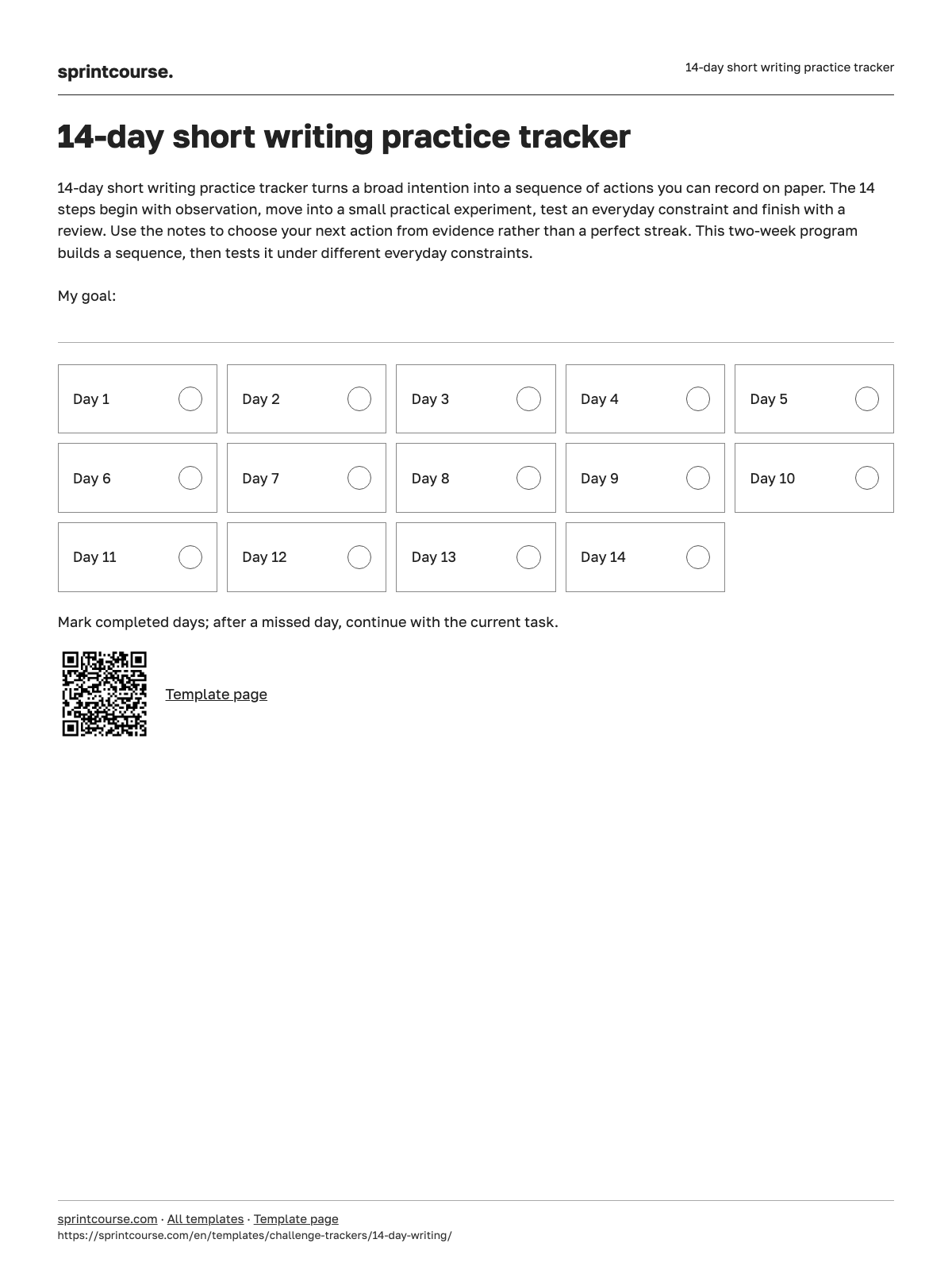
14-day short writing practice tracker turns a broad intention into a sequence of actions you can record on paper. The 14 steps begin with observation, move into a small practical experiment, test an everyday constraint and finish with a review. Use the notes to choose your next action from evidence rather than a perfect streak. This two-week program builds a sequence, then tests it under different everyday constraints.

Tracker first page

Free · no account needed

Your printable version

Download PDF Print

Opens a PDF. Choose the matching paper size and 100% scale in the print dialog. Links to the template and course are clickable in the file.

Online completion is coming later.

How to use it

  1. Choose one personal goal for short writing practice before you print. Describe an action you want to notice in everyday life, rather than an ambitious outcome you cannot check directly.
  2. Keep the overview and task pages together somewhere you will see them. Read the next task in advance and reserve a realistic time slot, including a smaller backup slot for a busy day.
  3. Mark the day after you try its action. Answer the note question in one concrete sentence: what you did, what happened, or which obstacle deserves another experiment.
  4. After a missed day, keep your completed marks. Resume at the next unfinished task and change one practical condition that got in your way, such as timing, materials or the size of the action.

Daily tasks

  1. Day 1

    Write the reader’s question in a single sentence. Choose an amount that fits today’s actual schedule. After trying the action, mark the day and save one useful observation.

    What happened when you tried to write the reader’s question in a single sentence, and which condition helped?

  2. Day 2

    Collect three observations that support an answer. Choose an amount that fits today’s actual schedule. After trying the action, mark the day and save one useful observation.

    What happened when you tried to collect three observations that support an answer, and which condition helped?

  3. Day 3

    Start the draft with a direct response to the question. Choose an amount that fits today’s actual schedule. After trying the action, mark the day and save one useful observation.

    What happened when you tried to start the draft with a direct response to the question, and which condition helped?

  4. Day 4

    Add a concrete example from a familiar situation. Choose an amount that fits today’s actual schedule. After trying the action, mark the day and save one useful observation.

    What happened when you tried to add a concrete example from a familiar situation, and which condition helped?

  5. Day 5

    Give two different arguments their own paragraphs. Choose an amount that fits today’s actual schedule. After trying the action, mark the day and save one useful observation.

    What happened when you tried to give two different arguments their own paragraphs, and which condition helped?

  6. Day 6

    Replace a vague word with an observable action. Choose an amount that fits today’s actual schedule. After trying the action, mark the day and save one useful observation.

    What happened when you tried to replace a vague word with an observable action, and which condition helped?

  7. Day 7

    Read the draft aloud and mark a difficult sentence. Choose an amount that fits today’s actual schedule. After trying the action, mark the day and save one useful observation.

    What happened when you tried to read the draft aloud and mark a difficult sentence, and which condition helped?

  8. Day 8

    Remove repetition that does not add meaning. Choose an amount that fits today’s actual schedule. After trying the action, mark the day and save one useful observation.

    What happened when you tried to remove repetition that does not add meaning, and which condition helped?

  9. Day 9

    Write a transition between two important ideas. Choose an amount that fits today’s actual schedule. After trying the action, mark the day and save one useful observation.

    What happened when you tried to write a transition between two important ideas, and which condition helped?

  10. Day 10

    Check that the headline matches the content. Choose an amount that fits today’s actual schedule. After trying the action, mark the day and save one useful observation.

    What happened when you tried to check that the headline matches the content, and which condition helped?

  11. Day 11

    Ask a reader to name the main point without hints. Choose an amount that fits today’s actual schedule. After trying the action, mark the day and save one useful observation.

    What happened when you tried to ask a reader to name the main point without hints, and which condition helped?

  12. Day 12

    Revise the passage the reader understood differently. Choose an amount that fits today’s actual schedule. After trying the action, mark the day and save one useful observation.

    What happened when you tried to revise the passage the reader understood differently, and which condition helped?

  13. Day 13

    Compare the finished text with the original question. Choose an amount that fits today’s actual schedule. After trying the action, mark the day and save one useful observation.

    What happened when you tried to compare the finished text with the original question, and which condition helped?

  14. Day 14

    Save your editing checks for the next piece. Choose an amount that fits today’s actual schedule. After trying the action, mark the day and save one useful observation.

    What happened when you tried to save your editing checks for the next piece, and which condition helped?

Tips for practice

Make the first short writing practice action easy to start

Set out the materials before your practice slot. When you only have five minutes, complete one small piece and name that piece in your notes. Leave the larger experiment for a day with more space. This makes the time limit visible and helps you choose a pace that fits your real schedule.

Record observations you can revisit

For short writing practice, separate what you observed from what you assumed. Replace a verdict about your ability with a description of the action, its result and one open question. A short specific note is useful at the next practice session because it tells you what to test rather than how to judge yourself.

Review before you add another challenge

Read the completed notes before starting a new cycle. Keep one action that helped and identify one condition that made progress harder. Test one adjustment at a time instead of increasing duration, difficulty and frequency together. A smaller repeatable experiment gives you a clearer comparison than a complete redesign of your routine.

Continue with the course

If you want more structured practice after short writing practice, explore the available Sprintcourse mini-courses and choose a relevant direction. There is no dedicated course for this particular program yet. You can complete the tracker on its own without an account or subscription.

Explore the course →

Questions and answers

Can I start on any day of the week?

Yes. The numbers show the order of tasks, not calendar dates. Write your own start date and continue at a practical pace. If your shifts or caring responsibilities change, choose a short backup slot in advance instead of relying on the same exact hour every day.

Should I start over after missing a day?

Keep the marks you already earned and continue with the next unfinished action. Note the cause of the break and one adjustment that would help you return. If the obstacle keeps appearing, reduce the size of the task or change its place in your schedule while preserving the sequence.

How do I print without cropping the page?

Download the version matching your paper: A4 or US Letter. Check the paper size and 100% scale in the print dialog; the layout already includes margins. Print the overview first, inspect the text and boxes, and then print the task pages you want to use.

Related templates

7-day short writing practice tracker

Challenge trackers · 7 days

7-day short writing practice tracker

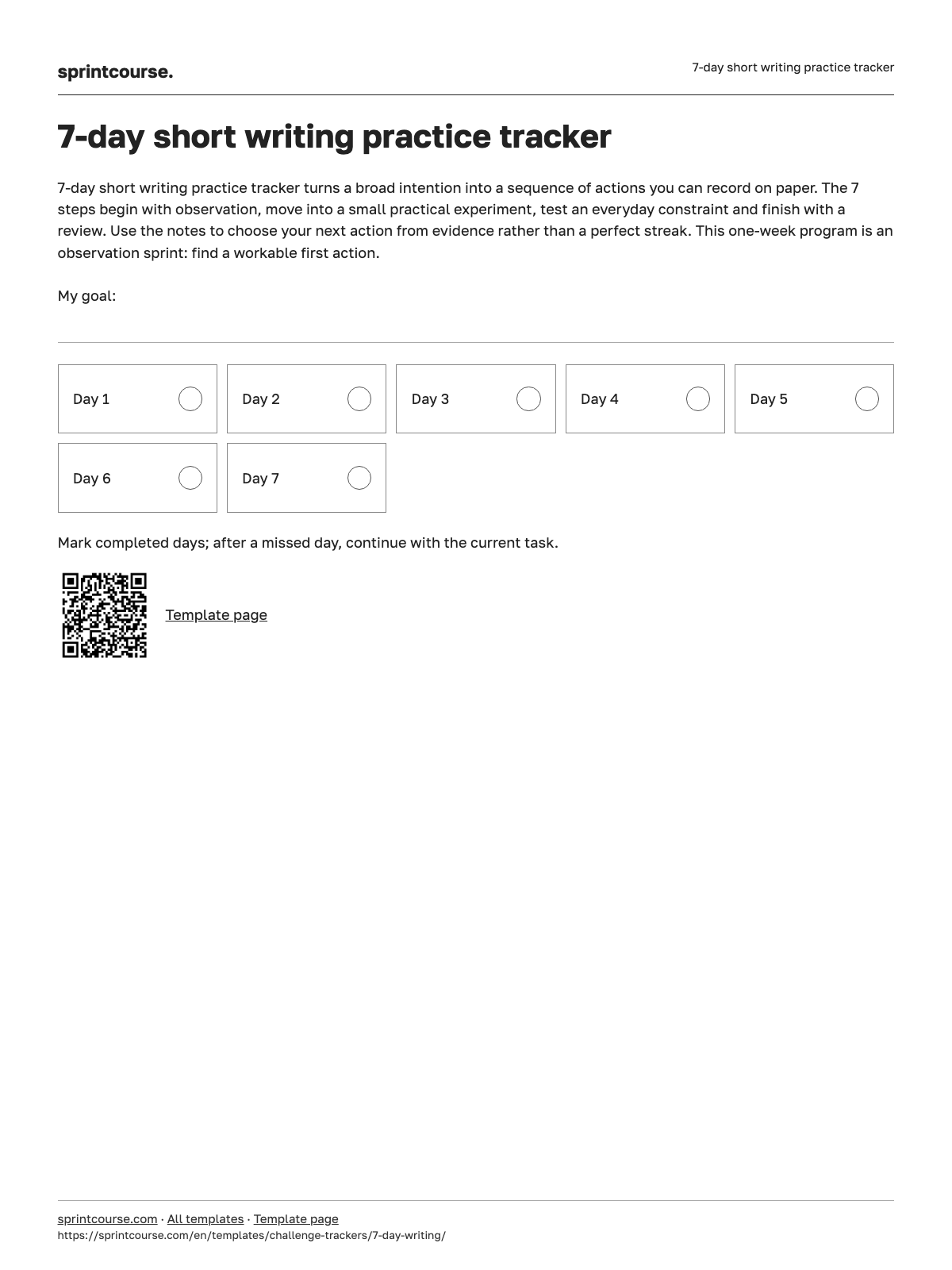
7-day short writing practice tracker turns a broad intention into a sequence of actions you can record on paper. The 7 steps begin with observation, move into a small practical experiment, test an everyday constraint and finish with a review. Use the notes to choose your next action from evidence rather than a perfect streak. This one-week program is an observation sprint: find a workable first action.

Choose and download →
14-day intentional phone use tracker

Challenge trackers · 14 days

14-day intentional phone use tracker

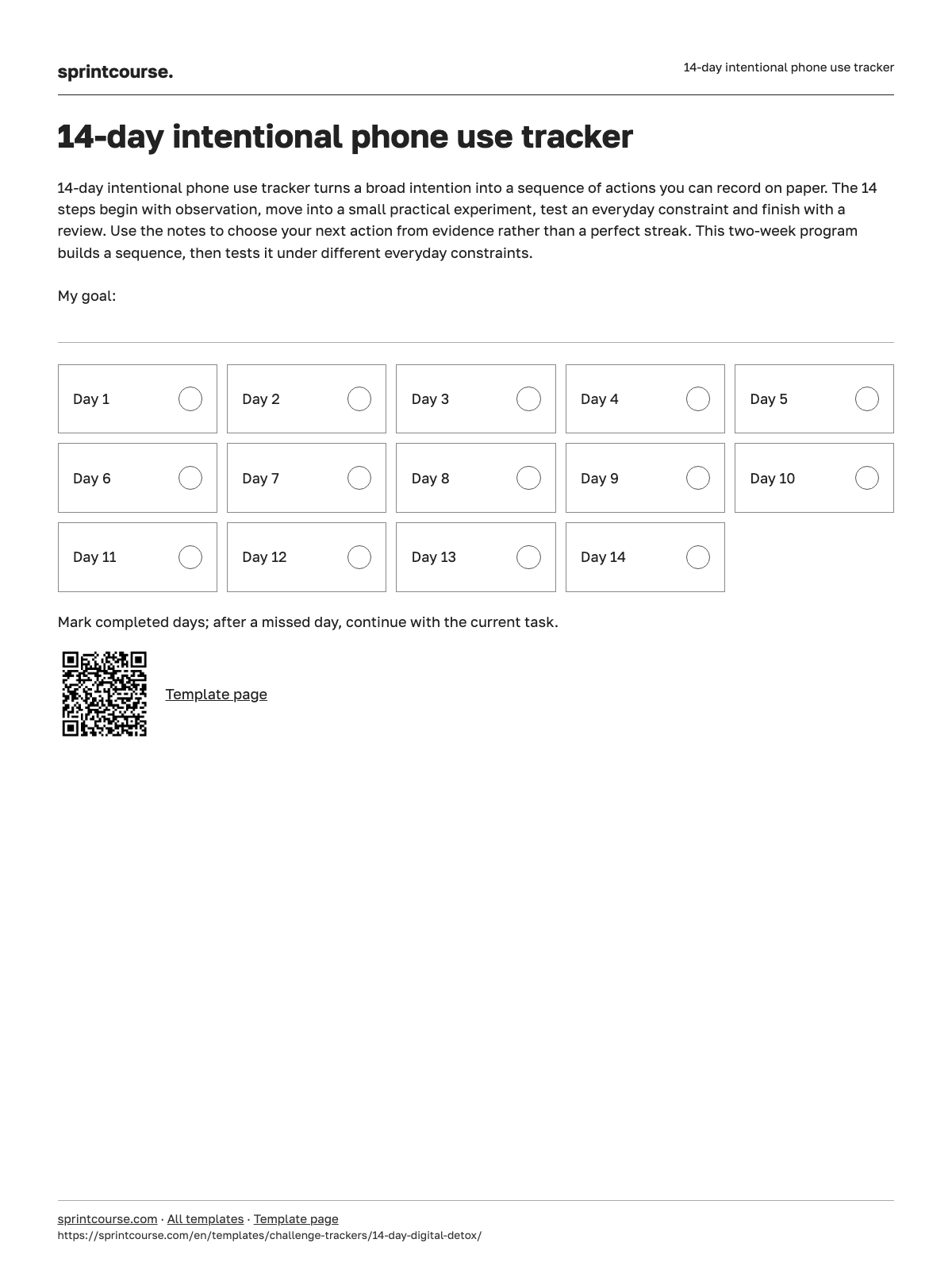
14-day intentional phone use tracker turns a broad intention into a sequence of actions you can record on paper. The 14 steps begin with observation, move into a small practical experiment, test an everyday constraint and finish with a review. Use the notes to choose your next action from evidence rather than a perfect streak. This two-week program builds a sequence, then tests it under different everyday constraints.

Choose and download →
14-day everyday spending notes tracker

Challenge trackers · 14 days

14-day everyday spending notes tracker

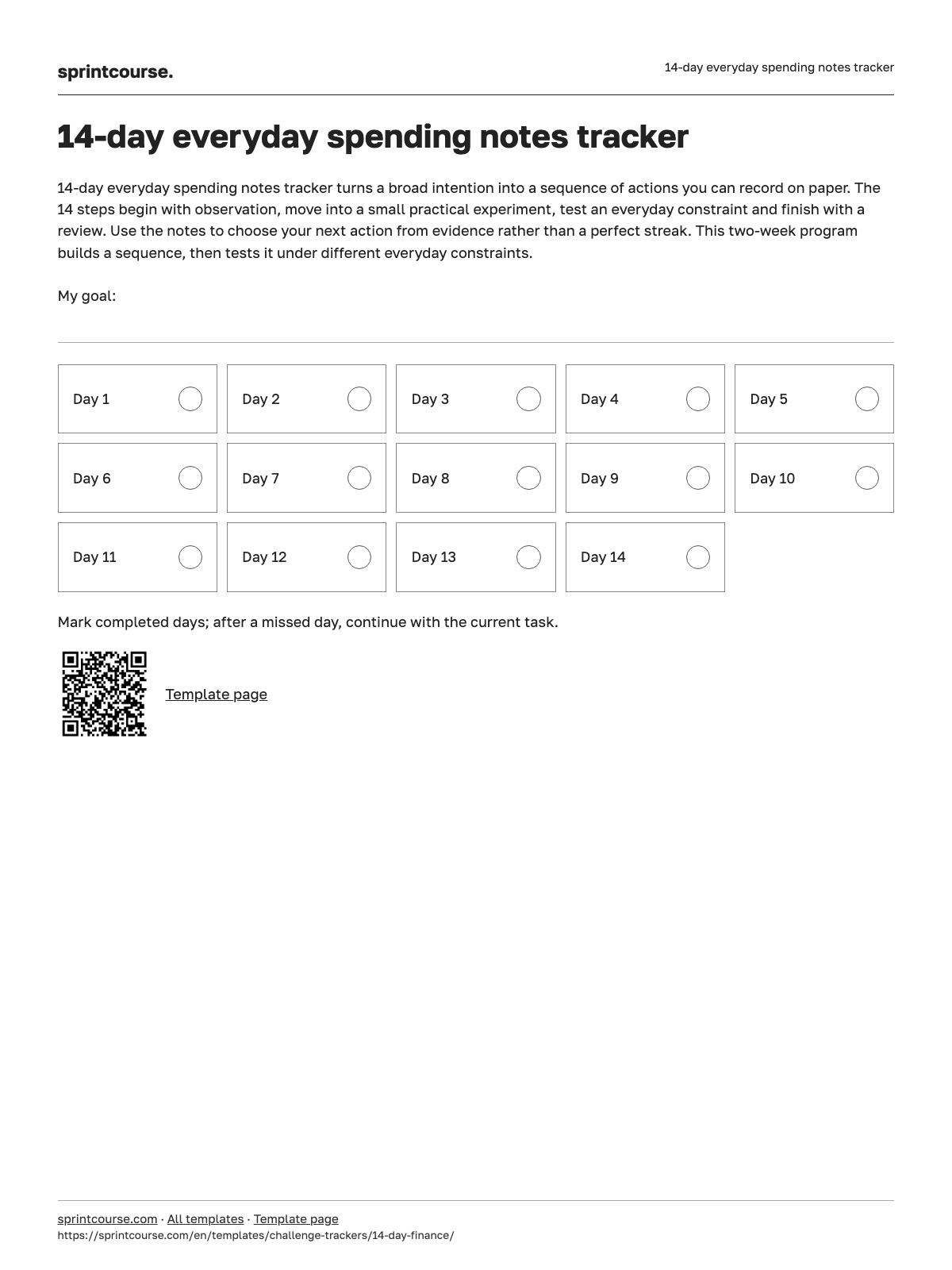
14-day everyday spending notes tracker turns a broad intention into a sequence of actions you can record on paper. The 14 steps begin with observation, move into a small practical experiment, test an everyday constraint and finish with a review. Use the notes to choose your next action from evidence rather than a perfect streak. This two-week program builds a sequence, then tests it under different everyday constraints.

Choose and download →
14-day daily movement tracker

Challenge trackers · 14 days

14-day daily movement tracker

14-day daily movement tracker turns a broad intention into a sequence of actions you can record on paper. The 14 steps begin with observation, move into a small practical experiment, test an everyday constraint and finish with a review. Use the notes to choose your next action from evidence rather than a perfect streak. This two-week program builds a sequence, then tests it under different everyday constraints.

Choose and download →