 sprintcourse
Lesson 6 of 30 · 12 min · 7 steps
Day 6. Finding keywords: where search demand comes from
The key idea
Start with seeds
A seed is a short phrase describing your product or topic: ‘coffee beans’, ‘coffee pot’, ‘bathroom renovation’. Each seed can lead to many real queries.
Five starting sources
- Autocomplete: type a seed and record useful suggestions. Try different first letters for the next word.
- People Also Ask and related searches: collect questions and alternative formulations.
- Keyword tools: Google Keyword Planner provides demand estimates; access requires a Google Ads account and available features depend on the account. Yandex Wordstat is useful when targeting its markets.
- Search Console or other webmaster tools: find queries your site already appears for, including opportunities outside the first page.
- Customers: chats, calls and reviews reveal wording that competitors may miss.
Paid tools can speed up research, but are not necessary for the first list.
Modifiers
People add qualifiers: price (‘buy’, ‘cost’), quality (‘best’, ‘reviews’), location (‘Bristol’, ‘near me’), problem (‘not working’, ‘how to fix’) and audience (‘for beginners’, ‘for offices’). A modifier can change intent; remember day 2.
Clean the list
Remove unrelated topics, brands you do not offer and queries your business cannot usefully answer. Do not automatically discard informational queries: keep those that support a relevant customer journey.
Growing a keyword list from a seed
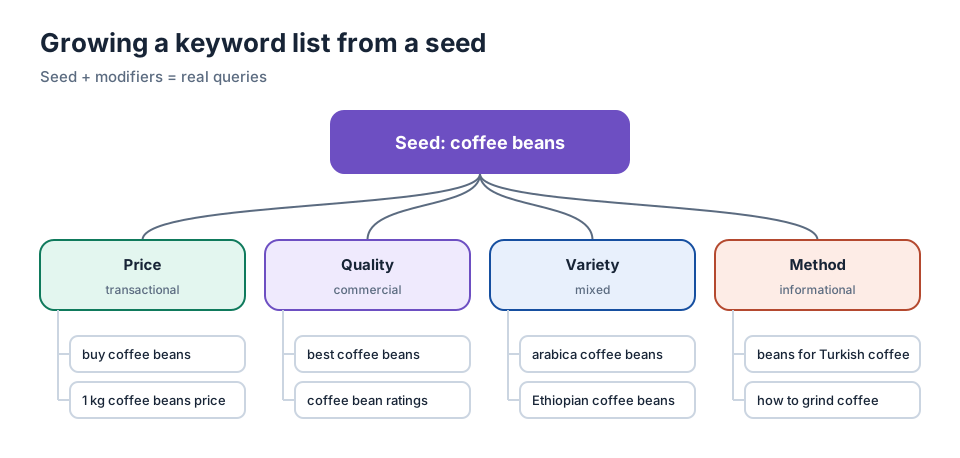
A keyword list: raw and cleaned
An online coffee shop collects suggestions for ‘coffee beans’.
Before
Unstocked brands, free offers and unrelated topics blur the list's focus.
After
Relevant queries are labeled by modifier and intent, ready for grouping.
How an expert reasons
For each phrase, ask whether your site can genuinely help. Remove irrelevant phrases and label modifiers now to make day-8 clustering easier.
The long tail
Specific queries often have modest individual demand but a clearer task. Taken together, relevant long-tail queries can help a small site find its first visitors. Specific wording does not automatically mean low competition.
Check your understanding
Check your understanding
Collect 30 queries
- Write three seed phrases for your business or blog.
- Collect ten queries per seed using suggestions, related questions or keyword tools.
- Remove irrelevant queries and label the modifier: price, quality, place, problem or audience.
Save the list in a spreadsheet for days 7–10. In your note, record the seeds and the number of queries after cleaning.
Saved automatically, even offline.