 sprintcourse
Lesson 4 of 30 · 10 min · 7 steps
Day 4. How search engines evaluate quality
The key idea
Helpfulness matters more than tricks
Search engines aim to surface helpful, reliable, people-first content. Google's E-E-A-T concepts help you assess quality:
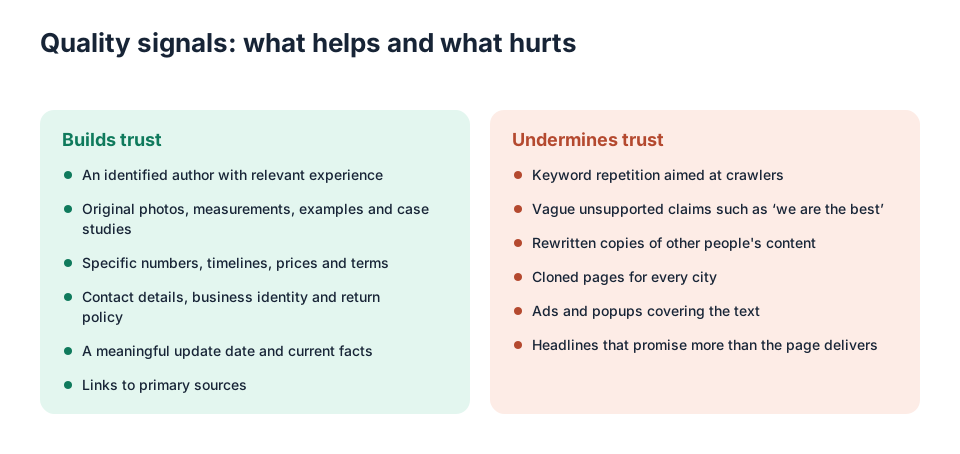
- Experience: the author has used, tried or done the thing. Original photos, measurements and lessons from mistakes provide evidence.
- Expertise: knowledge, accuracy and a sound explanation.
- Authoritativeness: recognition, citations and references in the subject area.
- Trustworthiness: clear ownership, contact information, honest pricing, transparent terms and a secure site. Trust is central.
E-E-A-T is a quality framework, not a single measurable ranking score. Other search engines also assess usefulness and business credibility.
Signs of weak content
- Repeated keywords, filler and claims without facts.
- Large volumes of near-identical pages, copied articles or unreviewed AI output without added value.
- A headline that promises something the page does not deliver.
- Intrusive ads and popups that obstruct reading.
A practical test
Ask: ‘Would I create this page for customers if search engines did not exist?’ A yes is a useful starting point.
Quality signals: what helps and what hurts
A paragraph for crawlers versus one for people
A bathroom renovation service page on a contractor's site.
Before
The keyword is repeated without timelines, prices or warranty details. The reader lacks the information needed to make contact.
After
The page provides a timeline, an illustrative price, a warranty and an experienced author, helping the visitor make a decision.
How an expert reasons
Replace repetition with facts a customer needs: time, price, warranty and who will do the work. Keep the service phrase naturally in the heading, rather than repeating it mechanically.
AI-generated content
Using AI is not automatically a problem. Producing large amounts of content to manipulate rankings without helping people is. Add firsthand experience, verify facts and edit carefully; otherwise your page adds little to existing results.
Check your understanding
Check your understanding
Audit trust on one page
Open a key service, product or article page and check:
- [ ] The author or company is identified and contact details are available
- [ ] Prices, times, numbers and terms are specific
- [ ] Photos and examples are original where relevant
- [ ] Keywords are not repeated mechanically
- [ ] Ads and popups do not block reading
Note which items are missing and what you will add first.
Saved automatically, even offline.