 sprintcourse
Lesson 7 of 30 · 11 min · 7 steps
Day 7. Search volume, difficulty and business value
The key idea
Three dimensions
1. Search volume: an estimate of monthly demand. Check the tool's location, language, date range and grouping rules. Broad aggregates and close-variant groups are not the same as demand for one exact phrase. In Wordstat, operators can narrow the matching; other tools use different definitions.
2. Difficulty: how hard it may be to compete. Inspect whether results are dominated by major brands, marketplaces or specialist sites. Tool difficulty scores are estimates, not facts about your particular site.
3. Business value: how closely a query supports your goal. ‘Buy copper coffee pot’ can be more valuable than ‘history of coffee pots’, even with lower volume.
A decision matrix
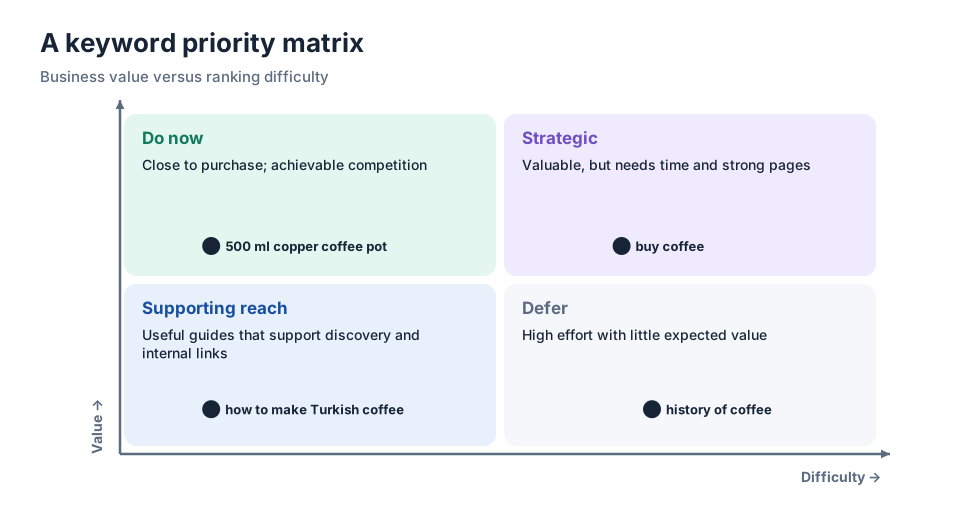
- High value, manageable difficulty: start here.
- High value, high difficulty: strategic projects that need time and strong assets.
- Lower direct value, low difficulty: useful supporting guides and internal links.
- Low value, high difficulty: usually defer.
Seasonality
Demand changes during the year. Cold brew may rise in summer; coffee gift sets around holidays. Inspect monthly patterns and prepare one or two months before the peak, allowing time for discovery and indexing.
A keyword priority matrix
How to interpret search volume
An illustrative comparison between broad demand and a narrower phrase estimate.
Before
Broad volume includes many additional phrases. Treating it as a visitor forecast creates a large overestimate.
After
A narrower estimate and an explicit click-through assumption create a more realistic comparison. All figures here are illustrative.
How an expert reasons
Use a demand estimate matching your target and multiply by a plausible CTR range. CTR varies greatly with the result layout and intent. Compare opportunities rather than treating the outcome as a promise.
Zero volume does not always mean no demand
New products, specialist B2B topics and long-tail queries can show 0–10 searches in a tool yet produce orders. Actual customer questions can be stronger evidence than a rounded zero.
Check your understanding
Check your understanding
Evaluate your list
Add three columns to the list from day 6:
- Volume: the most relevant estimate available, with location and matching assumptions noted.
- Difficulty: 1–3 after reviewing results; 1 for manageable competition, 3 for dominant brands and marketplaces.
- Value: 1–3; 3 for queries close to a lead or purchase.
Highlight five ‘Do now’ queries and save them in your note.
Saved automatically, even offline.