 sprintcourse
Lesson 8 of 30 · 12 min · 7 steps
Day 8. Clustering: which queries belong on one page
The key idea
Why group queries?
One page can rank for many related queries. Separate pages for every wording can compete with one another. Combining unrelated intents on one page can serve neither well.
A cluster is a group of queries one page can usefully answer.
Compare the results
Substantial overlap among the top ten URLs suggests similar intent. As a practical heuristic:
- Four or more shared URLs: consider one page.
- Zero to two: consider separate pages.
- Three: inspect intent and formats more closely.
These are research heuristics, not search-engine rules. Use the same language, location and device settings. Tools can automate comparisons; a small list can be checked side by side.
When a direct comparison is unavailable
- Synonyms and reordered words often belong together.
- Different tasks usually need different pages: ‘buy coffee pot’ versus ‘how to use a coffee pot’.
- Different products may need separate pages if the results show distinct needs, such as copper versus ceramic pots.
Clusters based on result overlap
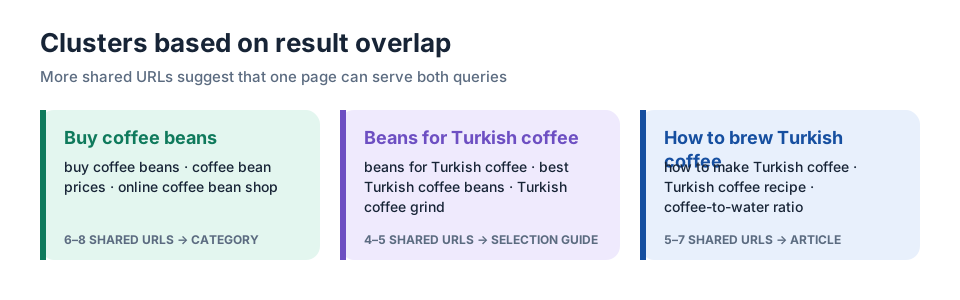
Comparing two result sets
Do ‘beans for Turkish coffee’ and ‘how to make Turkish coffee’ need one page or two?
Before
Similar wording tempts you to merge them, but the underlying tasks differ.
After
Only one of the top ten URLs overlaps. One set contains selections and stores; the other contains recipes. Separate pages are a better fit.
How an expert reasons
Compare the actual results. One shared URL suggests separate clusters here. Link the recipe to the bean selection so they support each other.
The primary query
Choose a main query that accurately describes the page, using demand as one input. It can guide the title and H1. Cover related variations naturally in subheadings, body copy and descriptions.
Check your understanding
Check your understanding
Group your queries
- Open your spreadsheet from days 6–7.
- Group synonyms and reordered phrases.
- Compare two or three uncertain pairs and count shared top-ten URLs.
- Pick a main query for each group.
Record the number of clusters and the uncertain pairs you checked, with the result.
Saved automatically, even offline.